Any document to any content
The NotebookLM alternative built to go open core. Upload PDFs, URLs, or Drive files — generate podcasts, quizzes, videos, summaries, flashcards, presentations, and 28 formats. Designed for self-hosting (open-core release in preparation), multi-provider, LLM-agnostic.
Built for every use case
From classrooms to enterprises to developer workflows.
Education
Teachers create quizzes, course plans, interactive presentations from their materials. Play live in class or share for self-paced learning.
Learn moreEnterprise
L&D teams build onboarding modules, compliance training, knowledge assessments from internal docs. Deploy on your infrastructure.
Developers
Integrate via API, CLI, or MCP server. Generate widgets programmatically. Embed anywhere with JSON Schema.
Widget catalog
28 formats across interactive, static, media, and pedagogical categories.
How it works
Three steps from document to learning content.
Upload
Import documents: PDF, DOCX, web pages, YouTube, PowerPoint.
Generate
Chat with AI or use the API to generate quizzes, podcasts, summaries, and more.
Share & Play
Self-paced, live sessions via Qiplim, embed, or export.
Studio creates. Qiplim plays.
Two apps, one workflow.
Studio
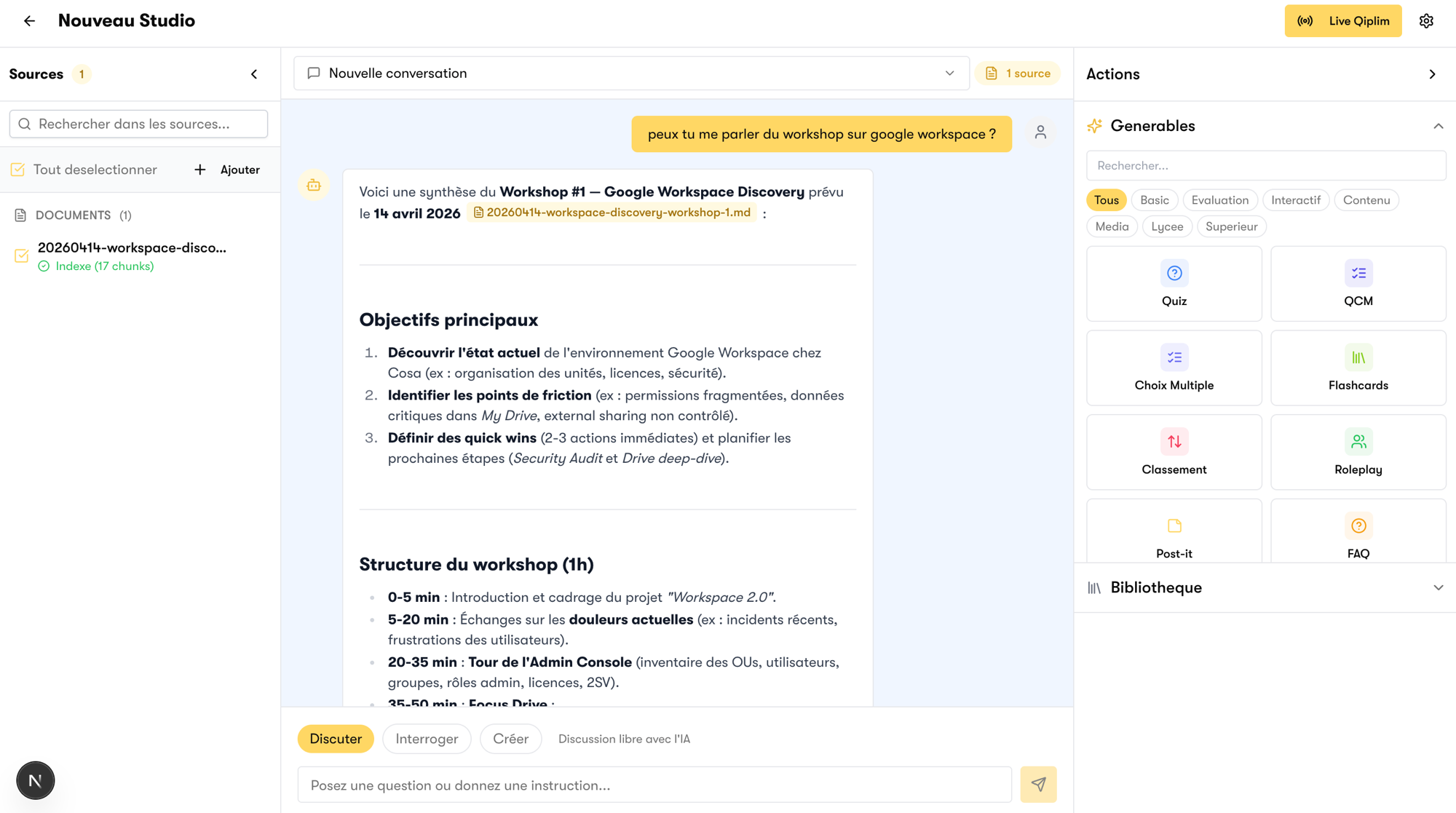
Upload documents, chat with AI, generate widgets, edit, compose, share.
Qiplim
Run live sessions with presenter + participants. Real-time interaction, leaderboards, instant feedback.
Technical features
Built for developers and IT teams.
Multi-LLM (BYOK)
Mistral, OpenAI, Anthropic, Google. Use your own API keys.
RAG-powered
Hybrid search with pgvector contextualizes AI generation with your source documents.
Real-time
Redis pub/sub, SSE streaming, Ably for Qiplim live sessions.
API-first
Generative API, CLI, MCP server for AI assistants.
JSON Schema
Every widget is a validated JSON spec. Export, embed, integrate anywhere.
Self-hosting (coming)
Docker, PostgreSQL, full data sovereignty. GDPR compliant.
Built to be open & self-hostable
Full control over your data, your infrastructure, and your code — that is the goal. The source code is not public yet: we are preparing an open-core release. The managed cloud (Pando Studio) is in private beta — access on request.
Security
Audit every line of code. No black box. Community-reviewed, transparent architecture.
Data sovereignty
Your data stays on your servers. No third-party access. Host in your country, your cloud, your rules.
Transparency
Transparent by design: see how AI processes your documents, no hidden data collection. License under definition for the upcoming open-core release.
Full control
Choose your AI providers (BYOK). Configure what's enabled. Update on your schedule. Fork if needed.
Enterprise-ready
Docker deployment, PostgreSQL, Redis. Production-grade infrastructure you already know.
Community-driven
Contribute widgets, fix bugs, shape the roadmap. Open governance, open development.
Self-host or use the managed cloud
Two ways to run Qiplim Studio. Pick the one that fits your team.
Self-host
You run it. You own everything.
- Deploy on your infrastructure (Docker, Kubernetes, bare metal)
- BYOK — bring your own provider keys (Mistral, OpenAI, Anthropic, Google, local)
- Model-agnostic — swap providers anytime, even point to a local LLM
- Your data never leaves your network. Your infra, your rules.
Cloud SaaS (Pando Studio)
We host it. You focus on creating content.
- Hosted in France (Clever Cloud), Mistral by default
- GDPR-compliant, AI Act-ready, support and SLA
- No infra to manage — request beta access and we set you up
- Same core as the upcoming open-core release, plus managed features (SSO, audit logs, multi-tenant)